Christians
Quo VadisThe Christians are a dispersed but increasingly numerous religious community whose faith becomes visible in the novel through acts of protection and mutual aid as well as through Roman suspicion. Their presence is first registered around Lygia: trusted members of her retinue share her faith, and the community offers a possible refuge when imperial custody threatens to separate her from those who care for her. Later, Vinicius’s search for Lygia brings him into contact with their discreet meetings, while the Great Fire gives the authorities an opportunity to turn popular prejudice into persecution.
Identity and Presence in Rome
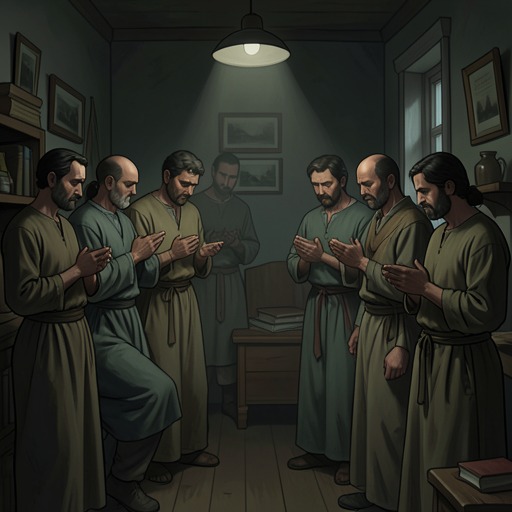
The Christians are described not as a single household or a publicly recognized institution but as a community spread throughout Rome. Chilo tells Vinicius that their numbers are so great that even members do not necessarily know everyone else, and that their caution and reticence make their networks difficult for outsiders to map. They gather for prayer in different locations, including empty houses and sand-pits, sometimes outside the city. Their meetings include worship of Christ, hymns, and shared feasts; the scattered venues and careful habits are both signs of communal life and responses to a hostile environment.
The community’s visibility is therefore uneven. Its size becomes clear to outsiders only indirectly: through the number of meeting places, the likelihood that household servants belong to it, and the difficulty of finding one particular fugitive among its members. Vinicius initially interprets the Christians as a Jewish sect and wonders why they meet in secret rather than worship in the daylight. Chilo answers that Christians face hostility from Jews as well as the populace, which accuses them of crimes and hates them. The novel thus presents secrecy not as proof of wrongdoing, but as a condition of religious life under suspicion.
Care for Lygia and Community Support
When Lygia is sent to Nero’s palace as a hostage, Pomponia arranges for her to be accompanied by servants she trusts. Alongside Ursus, she selects an older attendant and four young women—two skilled in hairdressing and two assigned to bathing—and chooses them because they adhere to the new faith. Pomponia hopes their presence will bring grains of truth into Caesar’s household. The arrangement turns an imposed transfer into an occasion for a small, carefully placed extension of the Christian community within the palace.
The Christians’ support is not merely symbolic. When Lygia fears being handed over to Vinicius, Ursus considers how to get her away without exposing her protectors to danger. He plans to seek the counsel of Bishop Linus, who may ask Christians to accompany him in rescuing her and hiding her beyond Rome’s reach. Ursus also believes he could gather many allies among enslaved people, gladiators, and free residents he knows in the Subura and across the bridges. His confidence in these connections gives concrete form to the community’s reach: a network of personal acquaintances that might be mobilized in a crisis.
For Acte, witnessing Lygia’s faith and the loyalty surrounding her discloses a different kind of happiness from the luxury of Nero’s household. She embraces Lygia and weeps, recognizing that suffering within a community of faith can coexist with a happiness she has not found amid palace excess. The contrast does not erase the cost of Lygia’s decision. She grieves leaving Pomponia and the household of Aulus, yet accepts an uncertain, wandering life because she believes she is following the Divine Master’s command and trusts that God will watch over her.
Belief, Rumor, and Encounters
Roman characters receive conflicting accounts of Christian belief. Before understanding the community, Vinicius hears the claim that Christians worship an ass’s head, oppose humanity, and permit disgraceful crimes. He questions this account against what he knows of Pomponia: her virtue and the way the household of Aulus treats its enslaved people seem inconsistent with the accusation that Christians are enemies of the human race. His uncertainty exposes the distance between hostile public rumor and the conduct he has observed.
The discovery of a fish drawn in the sand gives Chilo and Vinicius a clue in their search: Chilo concludes that Lygia is a Christian and that Christians have carried her away. The sign functions as an informal marker by which members may recognize a shared faith, but it also makes the community legible to an outsider who has learned to look for it. Chilo tries to exploit his new access, claiming that he has found a method for tracing Lygia through Christian contacts. His account of the community’s size and caution explains why the search is difficult, while his own motives make his apparent participation an unreliable basis for trust.
At Ostrianum, Vinicius sees the difference between rumor and the assembled community directly. The cemetery is entered through a guarded gate where two quarrymen examine visitors’ signs. Inside, graves lie beneath the crypt, a fountain stands before its entrance, and a large gathering forms in the open space because the underground chamber cannot contain everyone. Many attendees keep their heads covered, wary of betrayal or the cold. Torches are lit near the crypt, and the congregation sings a hymn whose yearning for rescue makes an impression on Vinicius. The gathering is both a worship service and a demonstration of how many people can assemble while remaining largely concealed from the city.
Imperial Power and the Politics of Worship
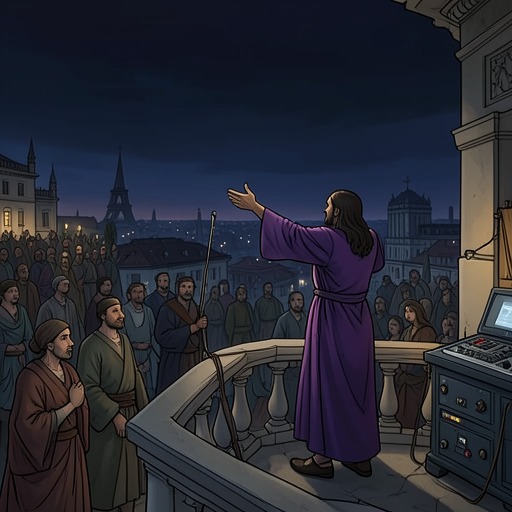
The Christians’ refusal to fit within Roman religious expectations becomes politically consequential at Nero’s court. When Nero asks Jewish priests whether they refuse to call him a god, their representative invokes the law of their faith and says that earlier envoys chose death rather than violate it. Chilo, by contrast, tells Nero that he believes whatever is useful and professes loyalty to the emperor while declaring hatred of Christians. The juxtaposition distinguishes a principled refusal of emperor worship from opportunistic courtly speech, while showing how easily the emperor’s demand for divine honors makes religious difference a test of political obedience.
The Christians’ communal practices likewise become vulnerable to political exploitation. After the Great Fire, Petronius tells Nero and the courtiers that they may punish the Christians but must admit among themselves that the Christians did not burn Rome. His intervention identifies the accusation as a performance designed for the populace, not a conclusion supported by evidence. Yet his warning does not undo the power imbalance: imperial authority, backed by the Praetorians, can transform a despised religious minority into victims for public spectacle even when a prominent courtier recognizes their innocence.
Narrative Significance
The Christians’ importance lies in the alternative forms of relationship their presence makes possible. Pomponia uses household influence to protect Lygia; Ursus imagines drawing on a broad network rather than acting alone; and the gathering at Ostrianum reveals a community whose members are numerous but not fully known to one another. These forms of support stand in contrast to the palace’s patronage, where access depends on favor and political calculation. Under Roman power, the community’s mutual reliance offers shelter and spiritual purpose, but its discretion cannot guarantee safety.
The novel also makes the Christians a test of how Rome interprets difference. Their secret meetings and refusal to honor the emperor are treated as grounds for suspicion, while their conduct toward Lygia and the poor complicates the accusations made against them. As the story moves from private protection to the threat of state persecution, their communal faith becomes both a means of sustaining individuals and a target through which imperial authority attempts to manage public fear.